- AI
- Product Design
- Agents
- Accessibility
- Design Leadership
The Agentic Product Team
I used AI-assisted coding to build an intelligent web app. Then I built a team of agents to run it. They triage customer feedback and tee up product recommendations that I can approve in one click and see deployed to production within minutes.
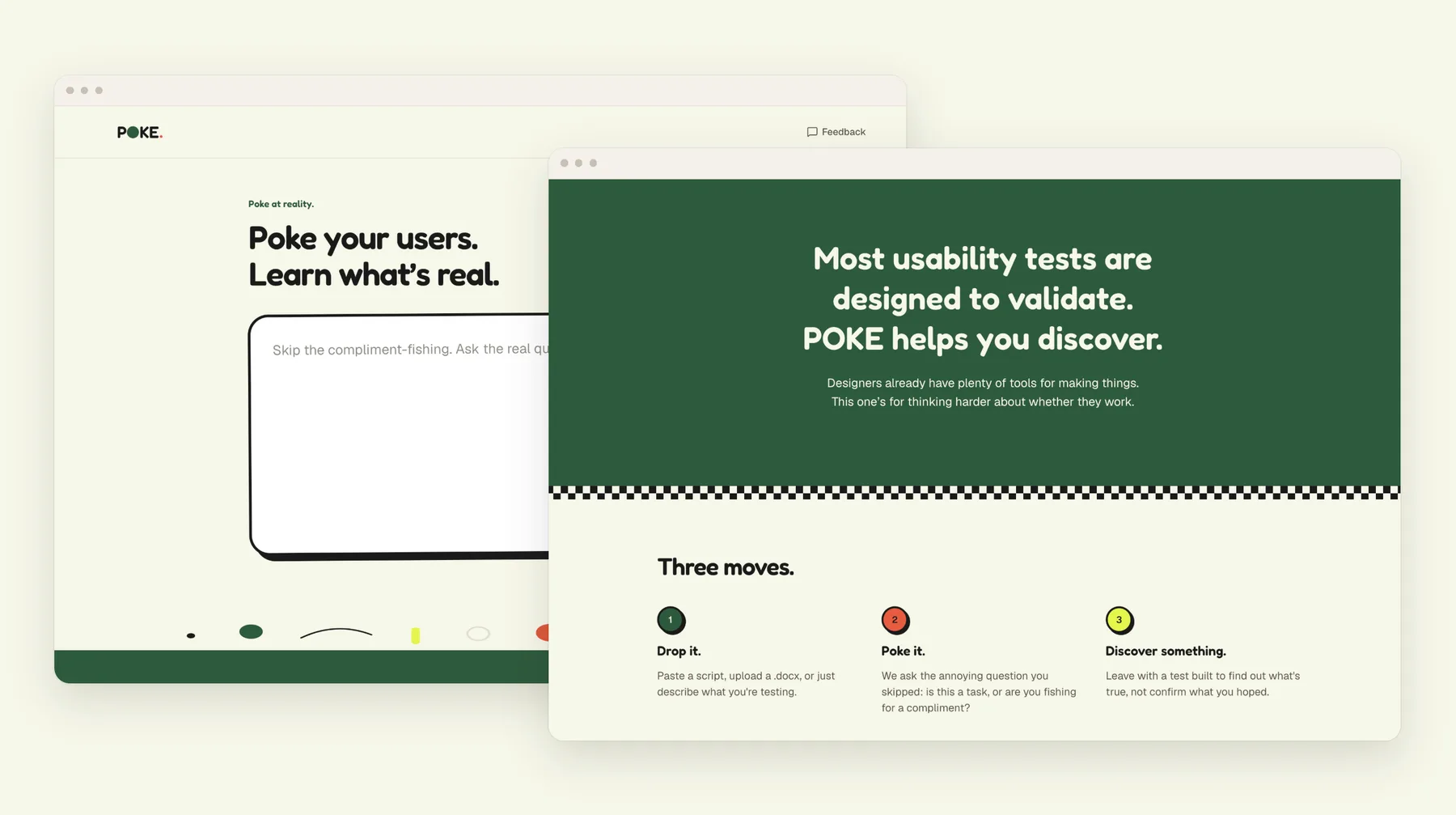
Poke your users. Learn what’s real.
POKE is a web app that grades usability test scripts. I built it with Claude Code. Then I built the team to run it: a Support bot, a PM bot, and a Design Engineer bot. I’m the Director of Product, and I make one decision, with one tap.
How it works
- A user uploads or pastes in an existing usability script. A custom Claude skill I developed grades it. If there isn’t enough information to grade, a second skill I built walks them through articulating their learning goals and methods first.
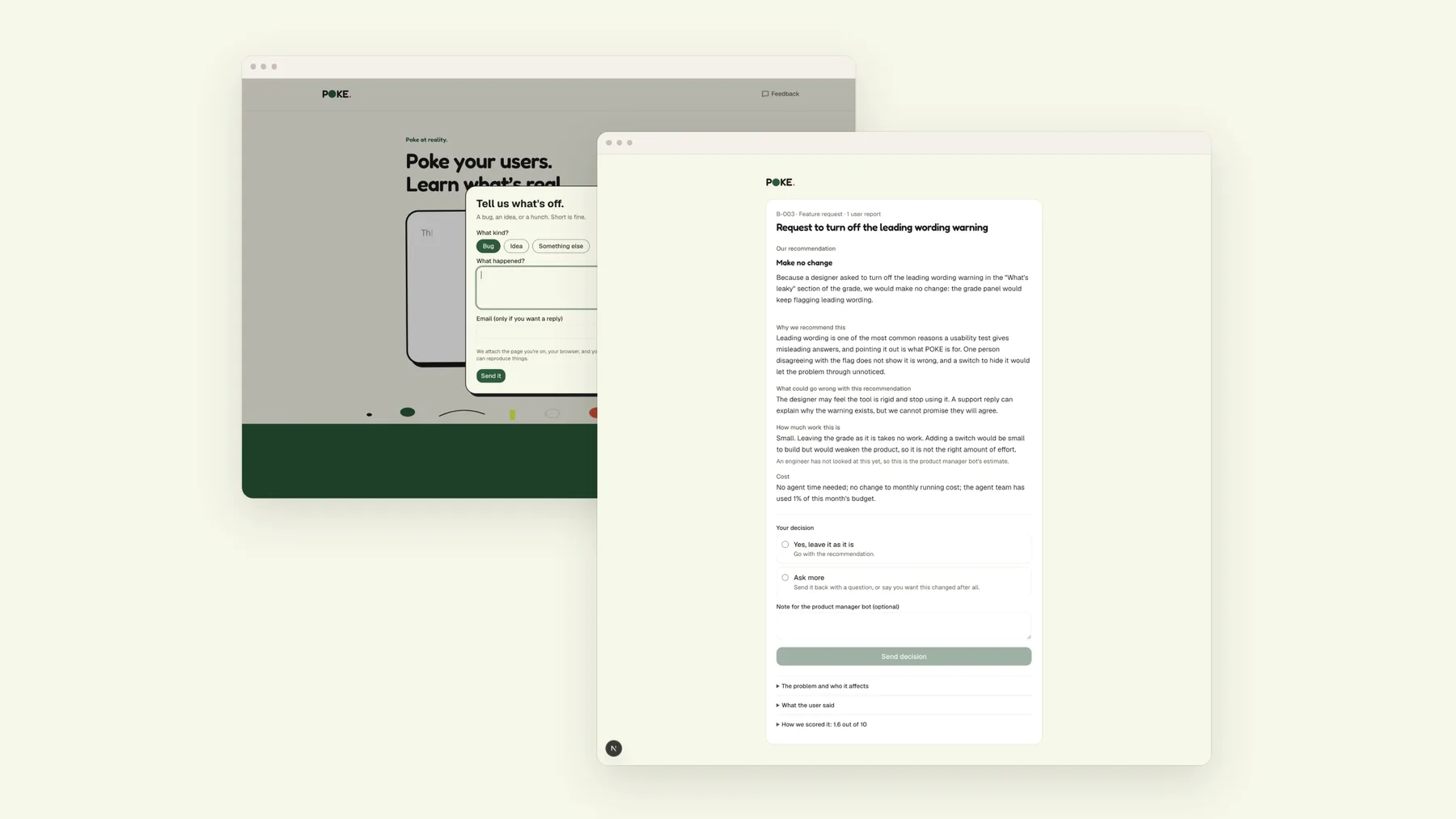
- If they encounter an issue or have an idea for a feature, they can submit a support ticket using a web form.
- Support bot replies in the product’s voice and triages it.
- PM bot groups duplicates, scores the item, and writes a recommendation in plain language.
- Design Engineer bot reads the real code, designs the fix, and flags the risk.
- The PM bot sends me a product triage document that I can review and approve with one tap. I can also deny the change or ask for more.
- If the change is small and safe, my approval ships it. It is built, checked, merged, and deployed, and Telegram tells me when it is live.
Key Takeaways
Running the whole stack makes cost tangible. In enterprise product design, the numbers are abstracted away. Here I watched real numbers on my own screen, and my cost estimate was off by about 3x. At this scale it’s pennies, but I know how wrong a 3x miss would be in a real product.
Everything is a trade-off. Polish the experience, or finish the plumbing first? Make the alerts easier for my support team to read, or fix the bugs so those tickets never reach them? I was managing a team of agent employees: estimating time, watching cost, and choosing what to leave undone.
Going end to end once tells you the real effort. A rough proof of concept shows what it would take to do it well, and what it would take to turn it into a product. A 40 minute demo can make something work, most things take about half a day to really work, and a dedicated sprint to work well.
Go deeper
- Read the full case study, with every step and screenshot
- Try the demo, which runs on canned data
- Watch the overview video
- See the code
Built as part of the Overclock Accelerator, in a cohort with the Project Management Institute (PMI) Software and AI Products team.